


Bathroom lighting zones are essential knowledge for all homeowners. Why? When you install a fixture with an incorrect IP light rating in a wet, humid, steamy environment, the potential of electrical fires increases significantly. In this guide, we will cover each bathroom lighting zone in detail to help you understand which light can go where and why.
Why can I Only put Certain Lights in a Bathroom?
You cannot just put any light in a bathroom, because not all lights are waterproof. Water-tightness does not just mean against direct splashes; it also refers to humidity and steam levels.
Standard indoor lights are breathable, which means moist air can get inside the housing. Eventually, moisture ingress will cause the light’s external metal components to corrode. And when corrosion occurs, the chances of short-circuits rise. In severe cases, this can cause the fixture to pop, melt, or start a fire behind your ceiling.
When you expose an ordinary indoor light to continuously high levels of moisture, corrosion occurs much faster. This process poses a significant safety risk, which is why specifically-designed bathroom light fixtures are available.
What is the Difference Between a Standard and Bathroom Light?
Although standard fixtures and bathroom lights appear identical, their internal engineering and build quality are worlds apart.
| Feature | Standard Lights | Bathroom Lights |
| Seals and Gaskets | Usually have gaps in the casing, which allow heat to escape. But also allow moisture to enter. Use silicone or rubber gaskets to create an airtight seal around every opening point. | Use silicone or rubber gaskets to create an airtight seal around every opening point. |
| Corrosion Resistance | Made of cheaper steel and finishes that will rust and flake within a year of constant steam exposure. | Constructed from polycarbonate, aluminium, or high-grade stainless steel and specialised coatings to protect against moisture. |
| Lens | It sits loosely in the frame and is often only decorative. It provides no water protection at all. | It is screw-sealed or tightly clipped to prevent condensation from pooling in the light bowl. |
| Earth and Insulation | Relies on standard grounding. | Designed so that no single failure can expose a dangerous voltage. |
What are IP Light Ratings?
IP light ratings detail how well a light’s electrical enclosure can prevent water, dust, and object ingress. The acronym stands for Ingress Protection, and each digit details the level of protection your light offers.
What do IP Light Ratings Mean?
IP light ratings have two digits. These represent their ability to prevent objects, dust, and water from getting in. The higher the number, the better the protection.
The first number refers to its object and dust protection, and is as follows:
- 0: No dust or object protection.
- 1-4: Protects against large objects and small wires.
- 5: Stops light-breaking dust from getting in, but not fully sealed.
- 6: Dust-tight, nothing gets in.
The second number refers to its protective level against water, and is as follows:
- 0: No water protection.
- 1-3: Protects against minimal sprays and vertical droplets (e.g., rain).
- 4: Splash-proof. This rating is the lowest required for bathroom use.
- 5-6: Jet-proof. These lights can handle water sprayed from a nozzle.
- 7: These lights can withstand temporary submersion (up to 30 minutes).
- 8: Designed for underwater use (e.g., pool or jacuzzi lights).
The most common IP light ratings are IP20, IP44, IP65, and IP68.
| Common IP Light Rating | What it Means | Where to Use it |
| IP20 | The light offers no protection against water, only large objects and wires. | Living rooms, bedrooms, or the outer bathroom lighting zones. |
| IP44 | The light is splash-proof but can not withstand submersion. | At least 60cm away from showers and near sinks. |
| IP65 | Water-jet proof. The light can only handle occasional heavy sprays, as it is not airtight. | Directly above showers or for outdoor garden lighting. |
| IP68 | The light is suitable for complete submersion. | Inside the floor of a shower or inside a bathtub. |
Why do Some IP Light Ratings Have an X?
Some IP light ratings have an X because their manufacturers did not formally test them for protection against solid objects or water. The most common examples of this are IPX4 and IP6X. The X is not necessarily symbolic of no protection, so much as insufficient data to prove its extent. Only when a light is rated 0 does it mean that the fixture offers no protection against a specific element.
What are the Bathroom Lighting Zones?
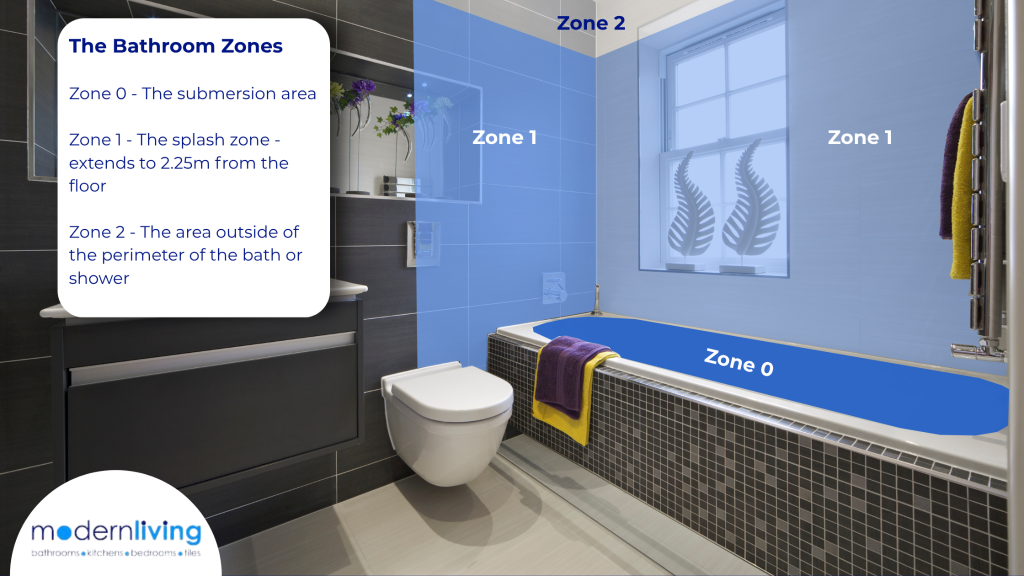
There are three bathroom lighting zones: Zone 1, Zone 2, and Zone 0. Each zone represents a different level of water exposure, accounting for human behaviour and accidents. These are as follows:
- Zone 1: Assumes you might splash bigger water droplets.
- Zone 2: Assumes you hit the ceiling with a detachable shower head water spray.
- Zone 0: Assumes your light is underwater.
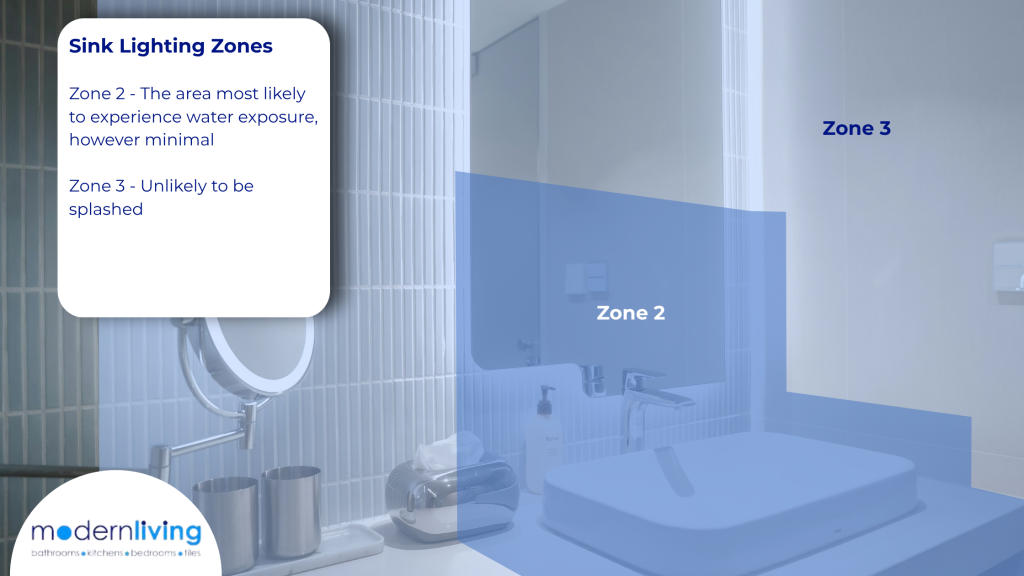
Another non-official bathroom lighting zone is Zone 3. This area is all surfaces surrounding zones 1, 2, and 0. It is unlikely that Zone 3 will experience any water exposure. But we recommend installing a light fitting rated to at least IP20 for assurance.
What are Zone 1 Bathroom Lighting Zones?
The Zone 1 bathroom lighting zone is the area directly above the bath or shower, extending to 2.25m from the floor. It covers the width of your shower cubicle or the length of the bath. Because this area is susceptible to water exposure, installing only specialised, low-voltage lighting (minimum IPX4) is essential.
If your shower has jets, a minimum IPX5, low-voltage fitting is required. Many choose recessed spotlights or enclosed light fittings to account for the high levels of moisture in Zone 1.
Important Note: For Zones 1 and 0, prioritise Safety Extra-Low Voltage (SELV) lighting. SELV lighting significantly reduces safety risks. Why? Because it uses a transformer that is located away from the bathroom zones to power the lights.
What are Zone 2 Bathroom Lighting Zones?
The Zone 2 bathroom lighting zone is the area surrounding Zone 1, extending to 600mm beyond it. It is a moderate-risk area that is susceptible to water spray but unlikely to experience high levels of water exposure. Waterproof bathroom lights are still necessary in Zone 2, and an IP light rating of at least IPX4 is required.
Important Note: If your ceiling measures higher than 2.4m, you have more freedom with light fixtures. Because this space is technically outside of the zone, a much lower level of protection is required. We always recommend choosing waterproof bathroom lights, just in case, but the limits on what you can do are not so stringent here.
What are Zone 0 Bathroom Lighting Zones?
The Zone 0 bathroom lighting zone is any area that is directly submerged in water, for example, the lights in a jacuzzi bath or on a shower floor. Because these fixtures are constantly in direct contact with water, they need a minimum IP rating of IPX7, and a low voltage (12V AC or 30V DC).
What are the Bathroom Lighting Zones in a Wet Room?
The bathroom lighting zones in a wet room are the same as those in standard bathrooms with enclosed showers and baths. However, because there are no shower trays or screens, the wall opposite your shower is technically Zone 1, not Zone 2. Furthermore, Zone 1 is not just the width of the shower head. It surrounds the 1.2m radius of your shower head’s centre point.
Do I Need Waterproof Bathroom Lights Around a Sink?
Yes, you do need waterproof bathroom lights around a sink. Bathroom lighting zones extend beyond the immediate shower and bath area and also apply to basins. If you place wall lighting surrounding your basin, it could fail due to splashing or heavy steam from a hot tap. So, consider the bathroom lighting zones when choosing an over-the-sink mirror.
Looking for Suppliers for Your Bathroom Renovation?
Choose Modern Living Direct as your trusted supplier of bathroom furniture. With over 40 years of experience, we know how to select the best brands and products for your renovation. Whether you are transforming your bathroom into a wet room, replacing your bath, or need bathroom cabinets, we’re here to help.
We offer products to suit all design needs and aesthetics. So if you prioritise a sleek modern look or a rustic vintage appeal, you will find what you need here.
Visit our showroom to see our selection of products for yourself and speak to our expert advisors. We are happy to provide recommendations and help you make your dream bathroom a reality. We also offer bespoke bathroom design services with end-to-end services, covering CAD design to installation.
Browse our website to find out more about our selection, and visit the Modern Living Direct showroom today.